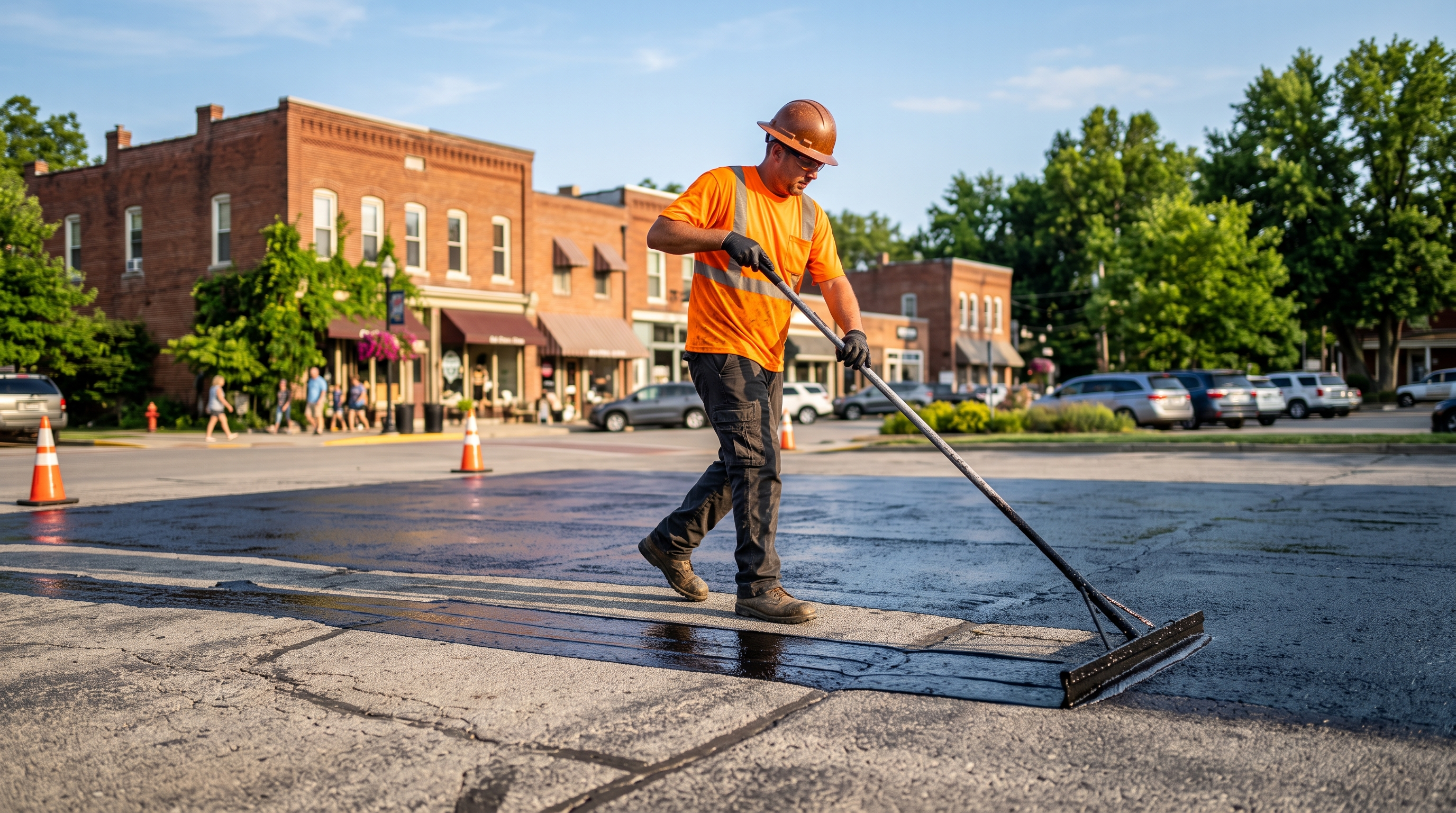
Your parking lot is the first thing every customer, tenant, and visitor sees before they ever walk through your door. In Lebanon, Ohio, where historic downtown storefronts sit alongside newer plazas off Route 63 and Columbus Avenue, a faded, cracked lot quietly tells people your property is not being looked after — while a freshly sealed, jet-black lot does the opposite. Here is what Lebanon business owners, property managers, and HOA boards should know before scheduling commercial sealcoating.
What does sealcoating actually do for a commercial parking lot?
Sealcoating applies a protective coal-tar or asphalt-emulsion layer over your pavement that blocks the three things that destroy asphalt: UV sunlight, water, and automotive fluids. Sunlight oxidizes the binder that holds asphalt together, turning it gray and brittle. Water works into small surface openings and, through Ohio’s freeze-thaw winters, pries them into real cracks and potholes. Oil and gasoline drips soften the pavement wherever cars park.
A sealcoat is sacrificial by design. It takes that abuse so your asphalt does not have to. Sealcoating a lot every two to three years can stretch the pavement’s useful life from roughly 15 years to 25 or more — and since full commercial repaving in southwest Ohio commonly runs several dollars per square foot versus cents per square foot for sealcoating, the math favors maintenance every time.
How much does parking lot sealcoating cost in Lebanon, OH?
Most commercial sealcoating in the Lebanon area falls in the range of roughly $0.15 to $0.30 per square foot, depending on the lot’s size, condition, and how much prep work it needs. A typical small business lot of 10,000 square feet usually lands in the low four figures. Three factors move the price:
- Lot condition. Cracks must be cleaned and hot-filled before sealer goes down. A lot with extensive cracking needs more prep labor than one that has been maintained on schedule.
- Number of coats. Commercial lots see far more traffic than driveways, so two coats is the standard — sometimes with a third pass on drive lanes and entrances where tires turn and scrub.
- Striping. Fresh sealcoat covers your existing lines, so re-striping stalls, ADA-accessible spaces, fire lanes, and arrows is part of nearly every commercial job.
Beware of quotes dramatically below that range. Low-ball pricing usually means watered-down sealer or a single thin coat, which can wear through in a year and puts you right back where you started.
How long does a commercial sealcoating job take?
Most Lebanon-area commercial lots are sealed in one day, but the lot needs to stay closed to traffic for 24 to 48 hours while the sealer cures. That cure window — not the application itself — is what business owners need to plan around. Foot traffic can usually resume sooner than vehicles, but tires on uncured sealer will scuff and track it.
The good news: a lot can be sealed in sections. A contractor can coat half the lot one day and the other half the next, so your customers always have somewhere to park and your business never fully closes. For restaurants, medical offices, and retail plazas around Lebanon, weekend or early-week scheduling keeps disruption to a minimum.
When is the best time of year to sealcoat a lot in Ohio?
Late spring through early fall is the sealcoating season in southwest Ohio, and mid-to-late summer is the sweet spot. Sealer needs pavement temperatures above roughly 50 degrees and a dry stretch of at least 24 hours to cure properly. July and August deliver exactly that: hot pavement, long days, and faster cure times — which also means shorter lot closures for your business.
Booking matters more than most owners realize. Reputable local crews fill their summer calendars weeks ahead, and once overnight temperatures start dropping in October, the window closes until spring. If your lot is showing gray, faded asphalt or spreading cracks now, this is the time of year to get on the schedule — waiting until spring means another Ohio winter of freeze-thaw damage working on every open crack.
What should be done before the sealer goes down?
Preparation determines how long the sealcoat lasts. A proper commercial job includes all of the following before any sealer is applied:
- Cleaning. The entire surface is blown, swept, or wire-brushed free of dirt and debris so the sealer bonds to asphalt, not dust.
- Oil spot treatment. Parking stalls collect oil drips, and sealer will not stick to petroleum residue. Spots get scrubbed and primed first.
- Hot rubberized crack filling. Any crack wider than about a quarter inch is filled with hot rubberized sealant. Sealcoating over open cracks just hides them — water still gets in, and the cracks reappear within months.
- Edging and masking. Concrete curbs, gutters, and sidewalks are protected so the finished job has clean, straight lines.
If a quote skips crack filling or oil treatment, the job will look great for a season and fail early. Ask specifically what prep is included.
Why does striping come after sealcoating?
Sealcoating and line striping go together because the fresh black surface completely covers your old lines. Once the sealer cures, new traffic paint is applied — and this is also the ideal moment to fix layout problems: adding ADA-accessible stalls that meet current code, sharpening faded fire lanes, or reworking traffic flow. Crisp white and yellow lines on new black sealcoat is the single biggest visual upgrade a commercial property can buy, and for HOAs and property managers it visibly signals to residents and tenants that dues are being put to work.
How do you choose a sealcoating contractor in Warren County?
Choose a local contractor who will walk the lot with you before quoting. A trustworthy commercial sealcoating quote is based on measured square footage and an honest assessment of crack repair needs — not a number over the phone. Look for a company that:
- Uses commercial-grade sealer applied at the manufacturer’s recommended dilution, not watered down to cut cost
- Includes hot rubberized crack filling and oil spot priming in the written scope
- Handles striping so you are not coordinating two contractors
- Can section the job so your business stays open
- Has local work you can drive past — ask for addresses of lots they sealed a year or two ago and see how they held up
Michelson’s Sealcoating is based right here in Warren County and seals commercial lots, HOA streets, and driveways across Lebanon, Mason, Springboro, Wilmington, and the surrounding communities. If your lot has gone gray or your lines have faded, request a free quote — we will walk the property, give you a straight answer on what it needs, and get you on the summer schedule before the season closes.